

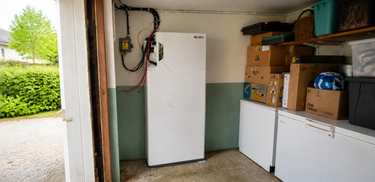
Germany EEG 2027 Explained: Why Solar, Battery Storage and Energy Management Are Becoming One System
Germany is preparing one of the most fundamental changes to its renewable energy support system since fixed solar feed-in tariffs helped create the country’s distributed photovoltaic market.
On 29 July 2026, the German cabinet approved the proposed EEG 2027 reform and a related grid connection package. The legislation is not yet final: it must still pass through the parliamentary process, and parts of the support framework will require approval under EU state aid rules. However, the direction is already clear. Germany intends to move renewable energy away from the traditional model of “generate electricity and receive a guaranteed payment” and towards a system built around:
- Direct electricity marketing
- Smart meters and controllability
- Solar self-consumption
- Grid-oriented operation
- Flexible demand
- Battery storage
- Active energy management
The EEG 2027 proposal does not introduce a legal requirement to install a battery with every new photovoltaic system. It does something more consequential: it weakens the economic model of unmanaged solar exports and increases the value of storing, controlling and consuming solar electricity locally.
That could make solar-plus-storage the economic default for many new German projects—even where storage is not legally mandatory.
The German Federal Government’s official summary describes the reform as a transition towards a more market-based, system-oriented and grid-compatible investment framework. The proposal must still be treated as draft legislation until the final parliamentary text is adopted.
What Is the Current Status of EEG 2027?
EEG 2027 is no longer only an early ministry discussion paper. The German cabinet approved the government bill on 29 July 2026. However, cabinet approval is not the same as final enactment.
The proposal can still be amended during the Bundestag process. The new support scheme must also comply with the EU electricity market reform and receive the relevant state aid approval from the European Commission.
| Legislative stage | Status as of 3 August 2026 |
| Ministry proposal | Completed |
| German cabinet approval | Completed on 29 July 2026 |
| Bundestag process | Pending |
| Final legal text | Not yet adopted |
| EU state aid approval | Still required for relevant support mechanisms |
| Intended implementation | From 1 January 2027, subject to final adoption |
Industry reporting by Clean Energy Wire notes that the Bundestag may still change parts of the proposal before final adoption.
The Three Most Important Solar Changes
1. Fixed Feed-In Tariffs for Small PV Will Be Phased Out
Under the current EEG framework, eligible rooftop solar installations can receive a fixed feed-in payment for electricity exported to the grid. For systems commissioned between 1 August 2026 and 31 January 2027, the current surplus feed-in tariff for the first 10 kW is 7.70 cents per kWh. Full-feed-in systems receive a higher rate.
The latest rates are published by the German Federal Network Agency. EEG 2027 proposes moving new systems away from this fixed-payment model and into direct electricity marketing.
For systems below 25 kW, permanent subsidies are expected to be largely discontinued. However, this should not be described as an immediate cliff edge for every small installation.
The cabinet proposal includes:
- A temporary, lower transition payment for eligible systems
- Different eligibility thresholds depending on the commissioning year
- A direct marketing bonus for smaller systems
- A maximum four-year period for the direct marketing bonus
- Expanded use of smart meters and controllable equipment
The policy objective is to give small generators time to enter direct marketing while gradually ending their reliance on guaranteed fixed payments.
Proposed Transition Path
| Commissioning year | Systems potentially eligible for the temporary payment under the cabinet proposal |
| 2027 | New systems below 50 kW |
| 2028 | New systems below 25 kW |
| 2029-2030 | New systems below 7 kW |
| From 2031 | No new temporary payment under the proposed schedule |
The precise thresholds and payment structure may change during the parliamentary process.
For solar installers, this changes the sales conversation. A PV system can no longer be evaluated only by annual generation and the assumed feed-in payment. Its control architecture becomes part of the investment case.
2. New Rooftop Solar Systems Would Face a 50% Export Power Limit
One of the most important—and most frequently misunderstood—elements of the EEG 2027 proposal is the 50% feed-in limit.
Under the current cabinet draft, relevant new rooftop PV systems in the second solar segment with an installed capacity below 100 kW would be required to limit maximum active power exported at the grid connection point to 50% of installed PV capacity.
For example:
PV capacity: 10 kWp
Maximum instantaneous export: 5 kW
Household demand at that moment: 2 kW
PV production at that moment: 9 kW
Without storage or flexible loads, only 5 kW could be exported. The remaining 2 kW would need to be curtailed because 2 kW is being consumed locally and 5 kW is already being exported.
With a battery, EV charger, heat pump or other controllable load, the remaining output could be absorbed instead of curtailed.
| Interpretation | Correct? |
| Annual grid exports are automatically cut by 50% | No |
| The grid connection can export only 50% of installed capacity at a given moment | Yes |
| Every PV project in Germany is covered | No |
| New qualifying rooftop systems below 100 kW are the main target | Yes |
| A battery is legally compulsory | No |
| Storage can reduce the energy lost through curtailment | Yes |
| Qualifying plug-in balcony solar is included | No |
| Zero-export systems are included | No |
The rule therefore affects the shape of the solar generation curve, not simply the annual number of kilowatt-hours sold.
How much energy is actually curtailed depends on:
- Roof orientation
- Regional solar yield
- DC-to-AC sizing
- Household or commercial load profile
- Battery power and usable capacity
- EV and heat-pump operation
- Weather forecasting
- EMS charging strategy
This is why a generic statement such as “the new rule cuts solar revenue in half” is incorrect.
3. Direct Marketing and Smart Control Move Downmarket
EEG 2027 is not only a subsidy reform. It is also a digitalisation reform.
The proposal would expand smart-meter and controllability requirements to smaller generation systems. The draft envisages extending the relevant rollout to generation plants above 2 kW, compared with the previous higher threshold.
At the same time, direct marketing would become the standard route for new solar electricity entering the market.
This matters because direct marketing is not simply a different payment method. It introduces new operational requirements:
- Metering and validated production data
- Communication with the direct marketer
- Remote controllability
- Forecasting
- Market-compliant settlement
- Management of low and negative-price intervals
- Contract and service fees
The direct marketing bonus can reduce the initial burden, but it does not eliminate the need for a functional digital ecosystem.
Direct Marketing Is Not the Same as a Dynamic Electricity Tariff. Direct marketing concerns how exported PV electricity is sold.A dynamic electricity tariff concerns how a household or company purchases electricity from the grid.
Since 1 January 2025, every German electricity supplier has been required to offer at least one dynamic electricity tariff. Germany’s wholesale day-ahead market also moved to 15-minute products for delivery from 1 October 2025. However, a customer does not automatically receive the raw wholesale price: supplier margins, network costs, taxes, metering and contract terms still apply.
Why EEG 2027 Increases the Value of Battery Storage
Battery storage creates value when the electricity recovered from the battery is worth more than the electricity that would otherwise have been exported, after accounting for losses and battery costs.
A more useful calculation than a generic payback claim is:
Incremental storage value per charged kWh =
avoided retail electricity cost × delivered battery energy − foregone export revenue − cycling and operating costs
Consider an illustrative benchmark:
Average household electricity price: 40.05 ct/kWh
Current surplus feed-in tariff for the first 10 kW: 7.70 ct/kWh
Delivered energy after battery and standby losses: 80%
The gross incremental value of storing one kilowatt-hour of solar electricity would be:
40.05 ct × 80% − 7.70 ct = 24.34 ct
This is not battery profit. Installation costs, degradation, financing, maintenance and taxes still need to be deducted.
It does, however, demonstrate the structural value gap between consuming solar electricity locally and exporting it at a relatively low tariff.
The German consumer advice organisation Verbraucherzentrale notes that a properly sized battery can increase the autonomy of a typical solar household from approximately 25–30% to as much as 70%. It also warns that oversized batteries can increase costs and accelerate ageing without producing a corresponding increase in useful self-consumption.
Implications for Residential Solar and Storage
Germany’s residential storage market is not simply growing in a straight line.
According to analysis based on RWTH Aachen University Battery Charts platform, Germany added an estimated 6.57 GWh of stationary battery capacity in 2025, bringing the total to approximately 24 GWh.
However, the segments developed differently:
| German storage segment | 2025 development |
| Home storage capacity additions | Down approximately 6.4% |
| Number of new home storage systems | Down approximately 20% |
| Average home battery capacity | Up approximately 8% to 10.3 kWh |
| Micro-storage systems below 1 kW | Up approximately 167% |
| Industrial storage capacity | Up approximately 47% |
| Large-scale storage capacity | Up approximately 81% |
The important residential trend is therefore not just installation volume. It is the transition towards larger, more integrated systems.
Household electricity demand is becoming more complex as homes add:
- Heat pumps
- Electric vehicles
- Smart wallboxes
- Dynamic electricity tariffs
- Backup power requirements
- Larger rooftop PV arrays
EEG 2027 reinforces this trend. A home battery is no longer valuable only because it increases independence. It can also help manage the export limit, avoid low-value feed-in periods and coordinate flexible household loads.
For professional installers and distributors, the Ultimati Energie RE-HA1 High-Voltage Residential Energy Storage System provides an all-in-one architecture with:
- 8–12 kW system power
- 7.6–22.7 kWh modular battery capacity
- Integrated residential storage design
- Scalable capacity for different household load profiles
- Compatibility with smart energy management through UltiCloud
The value proposition under EEG 2027 should not be reduced to “install a battery because exports are limited.”
Through the UltiCloud energy management platform, system decisions can take account of PV forecasts, household consumption, battery status and dynamic electricity prices rather than relying only on fixed charging periods.
Final
EEG 2027 does not legally create a “mandatory solar-plus-storage” market.
It creates something more commercially significant: a market in which unmanaged solar generation becomes progressively less attractive.
The reform weakens guaranteed export revenue, introduces stricter control of rooftop injection, expands digital requirements and exposes generators more directly to electricity-market conditions.
As a result, the economic hierarchy of a solar project changes:
- Use solar electricity locally
- Shift surplus into higher-value consumption periods
- Avoid curtailment and low-value exports
- Coordinate flexible electrical loads
- Participate in market trading where technically and commercially viable
The winners will not necessarily be the suppliers offering the cheapest battery cells or the largest nominal capacity.
They will be the companies that can combine reliable hardware, intelligent EMS control, professional commissioning, market integration and long-term local service.
For distributors, solar installers and EPC partners preparing for Germany’s next solar market phase, Ultimati Energie provides modular residential and commercial battery storage solutions supported by energy management, system integration and European technical service.
Explore Ultimati Energie Energy Storage Solutions
FAQs
Is battery storage mandatory under Germany’s EEG 2027 proposal?
No. The proposal does not legally require every new PV system to include a battery. However, the combination of lower export support and a 50% export power limit could make storage economically important for many projects.
What does the 50% solar export limit mean?
It limits instantaneous active power exported at the grid connection point to 50% of installed PV capacity for qualifying new systems. It does not automatically reduce annual exported energy by 50%.
Will Germany end all feed-in tariffs on 1 January 2027?
Not immediately for every small installation. The cabinet proposal includes a phased transition, temporary payments for defined system sizes and a four-year direct-marketing bonus.
Which solar systems would face the 50% limit?
Under the current cabinet proposal, the main scope is qualifying new rooftop PV systems in the second solar segment with capacities below 100 kW. The final legal scope may change during the parliamentary process.
Does the 50% limit apply to balcony solar systems?
Qualifying plug-in solar devices are excluded from the permanent 50% export restriction under the current cabinet proposal.
Why does EEG 2027 increase the value of an EMS?
An EMS can coordinate PV production, battery charging, site consumption, export limits, dynamic tariffs, EV charging and heat-pump operation. These functions become more valuable as fixed export payments decline and market exposure increases.
When is EEG 2027 expected to take effect?
The proposed implementation date is 1 January 2027. The legislation must first complete the parliamentary process, and relevant support mechanisms may require European Commission state aid approval.

Ultimati Energie Deutschland GmbH er en tysk leverandør af B2B-energilagringssystemer, der specialiserer sig i skalerbare batterilagringsløsninger til boliger og C&I til europæiske partnere.
Bliv partner
Salg: +49 1624886367
Kundeservice:
+49 15226994869
Adresse: Ober der Röth 4, 65824 Schwalbach am Taunus, Tyskland
Copyright © 2026 Ultimati Energie Deutschland GmbH. Alle rettigheder forbeholdes.